
Pharmaceutical manufacturing services cover outsourced production of drug products — formulation, batch manufacturing, quality control, packaging and documentation — delivered through a contract manufacturer, third-party manufacturer, or CDMO. The right model depends on whether you need only production capacity or also formulation and development support.
If you’re evaluating pharmaceutical manufacturing services, the first decision isn’t which company to hire — it’s which model fits your product. A contract manufacturer runs production against your specs. A third-party manufacturer does something similar under a broader commercial arrangement. A CDMO goes further and helps develop the formulation itself. Picking the wrong model wastes more time than picking the wrong vendor within the right model.
This guide breaks down what these services actually involve, what dosage forms are realistic to outsource, where India’s GMP requirements stand heading into 2026, what actually drives cost, and — more usefully — what experienced buyers check before signing anything.
What Pharmaceutical Manufacturing Services Actually Cover
Takeaway: Pharmaceutical manufacturing services are outsourced production arrangements covering some combination of formulation, batch manufacturing, quality control, packaging and regulatory documentation — the exact scope is defined by contract, not by the label “manufacturing services.”
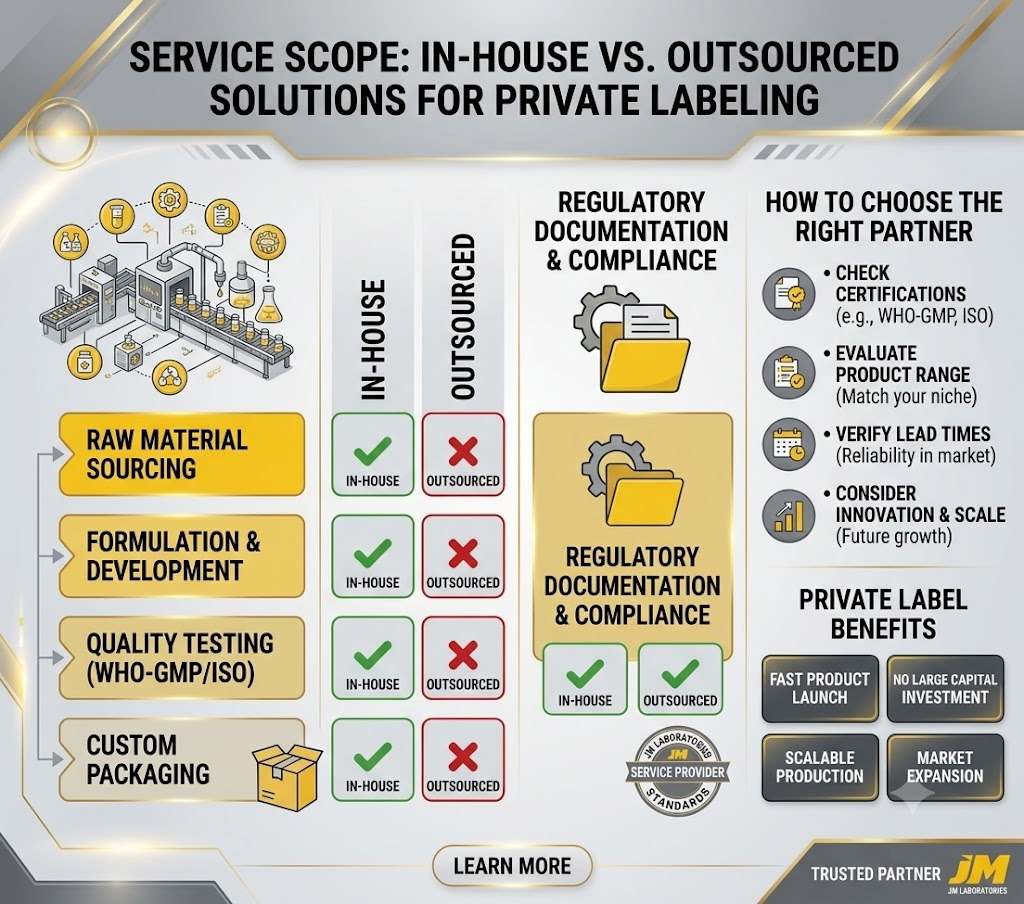
That last part matters more than it sounds. Two companies can both call themselves “pharmaceutical manufacturing service providers” while one only runs your finished formulation through their line, and the other handles everything from raw-material sourcing to stability testing. Before comparing pricing, get clarity on scope: formulation and product development, batch and scale-up manufacturing, quality assurance and quality control testing, packaging and labeling, and documentation support (batch records, certificates of analysis, stability data).
A manufacturer that’s vague about which of these it actually performs in-house — versus subcontracts further — is usually the one worth a second, harder look.
Contract Manufacturing vs Third-Party Manufacturing vs CDMO
Takeaway: Contract manufacturing and third-party manufacturing both mean outsourced production, but a CDMO is the one to consider if you need formulation development, not just a production line.
The terms get used almost interchangeably in India’s pharma marketing content, which is exactly why buyers get confused. Here’s the practical distinction:
| Model | What it actually means | Best fit when… |
|---|---|---|
| Contract Manufacturing (CMO) | Manufacturer produces against your finalized formulation and specs | You already have a validated formulation ready to scale |
| Third-Party Manufacturing | A common Indian commercial model where a marketing/distribution company sources products from a manufacturer under its own brand | You want to build a product portfolio without owning a plant |
| CDMO | Development + manufacturing under one roof | You need formulation work, technology transfer, or process development before production even starts |
| Private Label / OEM | Manufacturer produces a standard or lightly customized product under your brand | You want speed to market over customization |
If you’re not sure which one you need, ask yourself one question: do I have a finished, validated formulation, or do I still need someone to help build it? That single answer eliminates half the shortlist.
What a Manufacturing Partner Does, Stage by Stage
Takeaway: A pharmaceutical manufacturing partner’s actual work runs through formulation (if applicable), production, in-process and finished-product testing, packaging, and batch documentation — and weak points tend to show up at the testing and documentation stages more than in production itself.
Formulation development. Where applicable, this covers formulation design or optimization, prototype batches, stability assessment, and scale-up feasibility. Skip this stage entirely if your product is already validated — paying for development work you don’t need is a common way buyers overspend early.
Manufacturing. Raw materials are dispensed, processed according to the approved manufacturing procedure, and moved through in-process checks before the batch is finished. This is the part most manufacturers show off in sales calls, and honestly, it’s the part least likely to go wrong if the facility is legitimate.
Quality control and assurance. Testing at the raw-material, in-process, and finished-product stages, plus batch documentation, deviation handling, and change control. This is where corners actually get cut when manufacturers are under-resourced — ask for sample certificates of analysis before you ask about anything else.
Packaging and labeling. Blister or strip packing, bottle filling, sachets, cartoning, batch coding — capability here varies more between manufacturers than most buyers expect, especially for less common formats like unit-dose sachets or child-resistant closures.
Documentation. Batch manufacturing records, specifications, testing data, and — depending on the agreement — support for regulatory filings. Get explicit about who owns responsibility for this before signing, not after a batch fails an audit.
Dosage Forms: What Can Actually Be Manufactured
Takeaway: Not every manufacturer that lists “tablets, capsules, syrups, injectables” on their homepage is actually licensed and equipped for all four — injectables in particular require sterile manufacturing infrastructure that most third-party manufacturers don’t have.
Common outsourced dosage forms include tablets, capsules, oral liquids and syrups, dry syrups and powders, topical creams, ointments and gels, softgels, and sachets. Injectables sit in a different category entirely: they require sterile manufacturing environments, dedicated validation, and specific regulatory authorization, so treat any injectable-manufacturing claim with more scrutiny than a tablet or capsule claim. If a manufacturer’s website lists injectables alongside a dozen other dosage forms with no mention of sterile facilities, ask directly — don’t assume.
GMP and Schedule M: Where India Stands in 2026
Takeaway: Revised Schedule M — India’s updated GMP framework aligned with WHO standards — is now binding on manufacturers of every size, after a phased rollout that gave large manufacturers until mid-2024 and smaller units until the end of 2025 to comply.
This is where a lot of pharma manufacturing content online is already outdated, so it’s worth getting the timeline right. The revised Schedule M requirements under the Drugs and Cosmetics Rules, 1945 took effect for large manufacturers — those with turnover above ₹250 crore — from June 28, 2024. Smaller manufacturers were initially given a shorter window, but after industry representations about infrastructure and financing constraints, the health ministry extended their compliance deadline to December 31, 2025. Health ministry extends Schedule M for pharma sector +2
Practically, this means that by 2026, GMP-related quality upgrades — equipment qualification, computerized data-integrity controls, formal change-control and recall procedures — are no longer optional extras a manufacturer can defer. If a manufacturing partner still describes revised Schedule M compliance as “upcoming” or “in progress” without a clear timeline, that’s worth a direct question, not a shrug.
Under the framework, WHO-GMP certification remains a separate, higher bar than baseline Schedule M compliance — useful to know if you’re evaluating manufacturers for export markets, where buyers often specifically require WHO-GMP rather than domestic GMP alone.
[Visual / Diagram Suggestion: A timeline graphic showing Schedule M notification (Dec 2023) → large manufacturer deadline (June 2024) → MSME deadline (Dec 2025) → current enforcement phase (2026).]
What Drives Pharmaceutical Manufacturing Cost
Takeaway: There’s no standard price list for pharmaceutical manufacturing — cost is driven by active ingredient sourcing, batch size, dosage form complexity, packaging format, and testing requirements, and any manufacturer quoting a number before reviewing your specs is guessing.
The honest answer to “how much does contract manufacturing cost” is: it depends on enough variables that a real quote requires your actual product specs. What consistently moves the number: API cost and sourcing difficulty, batch size and minimum order quantity, dosage form (a simple tablet costs far less to produce than a sterile injectable or a specialty softgel), packaging format and artwork complexity, and the depth of testing and documentation required. Manufacturers who give you a firm number in the first conversation, before seeing your formulation, are usually either quoting a generic starting price or padding for negotiation room — neither is useful for planning.
How to Vet a Manufacturing Partner
Takeaway: Price comparisons come after facility, certification, and quality-system checks — not before — because the cheapest quote from an unverified facility is the most expensive mistake in this industry.
Before you sign anything:
- Verify the facility, not just the website. Get the actual manufacturing site address, licenses, and which dosage forms it’s approved for — not just a list of capabilities on a landing page.
- Ask for the certificate, not the claim. “GMP certified” means little without the certifying body, certificate number, scope, and current validity date. Request to see it.
- Confirm product-specific experience. A manufacturer strong in tablets isn’t automatically competent in sterile liquids — ask what they’ve actually produced in your dosage form.
- Get sample QC documentation. A certificate of analysis from a past batch tells you more about their quality discipline than any sales pitch.
- Clarify MOQ and batch economics upfront. Minimum order quantities vary widely by product and can quietly make a “cheaper” manufacturer more expensive at your actual volume.
- Pin down regulatory responsibility in writing. Who owns product registration, label compliance, and documentation — you or them? Get this in the contract, not a verbal assumption.
- Test communication before committing volume. How a manufacturer handles your questions during evaluation is a reasonable preview of how they’ll handle a production issue later.
Where Outsourcing Helps — and Where It Doesn’t
Takeaway: Outsourcing manufacturing removes the need to build your own facility, but it doesn’t remove your responsibility for quality oversight, supplier audits, or regulatory accountability — that risk simply moves, it doesn’t disappear.
The genuine upside is real: access to manufacturing infrastructure and specialized capabilities without capital investment in your own plant, faster scaling when demand grows, and technical support you’d otherwise have to build internally. But it’s worth being direct about the trade-off most marketing pages skip — outsourcing shifts operational risk to a partner, it doesn’t eliminate it. If your manufacturer has a quality lapse, a recall, or a supply disruption, it’s still your product and your brand exposure. That’s exactly why the vetting checklist above matters more than the sales pitch.
Common Mistakes Buyers Make
Takeaway: The most expensive mistakes in pharma manufacturing sourcing happen before production starts — choosing on price alone, skipping facility verification, and leaving regulatory ownership undefined.
A few patterns show up repeatedly with first-time buyers: picking a manufacturer on quoted price without checking certification scope, assuming “third-party manufacturing” and “contract manufacturing” are interchangeable when the commercial terms differ, underestimating how much MOQ affects true unit cost, and not clarifying upfront who’s responsible for regulatory filings if something needs correcting later. None of these are exotic risks — they’re the ordinary ones that a half-hour of upfront verification would catch.
Key Takeaways
- Pharmaceutical manufacturing services span formulation, production, QA/QC, packaging and documentation — scope should be defined in the contract, not assumed from the label.
- A CDMO is the right fit if you need formulation development; a contract or third-party manufacturer is enough if your product is already validated.
- Injectables require sterile manufacturing infrastructure — verify this specifically rather than trusting a general capabilities list.
- Revised Schedule M is now binding on manufacturers of every size in India, following deadlines of June 2024 (large manufacturers) and December 2025 (MSMEs).
- There’s no fixed price for contract manufacturing — cost depends on API, batch size, dosage form and packaging.
- Facility and certificate verification should happen before price comparison, not after.
FAQs
What’s the difference between contract manufacturing and third-party manufacturing in India?
Both are outsourced production arrangements. Contract manufacturing typically means a manufacturer produces against your finalized specs, while third-party manufacturing is a broader commercial model common in India where a marketing or distribution company sources products under its own brand from a manufacturer.
What is a CDMO, and do I need one?
A CDMO (Contract Development and Manufacturing Organization) provides formulation development in addition to manufacturing. You need one only if your product isn’t already a finished, validated formulation.
Is GMP certification enough, or do I need WHO-GMP specifically?
It depends on your market. Domestic Indian sales generally require Schedule M / GMP compliance; export to markets that specifically demand it will require WHO-GMP certification, which is a distinct, higher-bar credential.
Can any pharma manufacturer produce injectables?
No. Injectable manufacturing requires sterile facilities, specific validation, and separate regulatory authorization — don’t assume a manufacturer offering tablets and capsules can also produce sterile injectables.
How long does pharmaceutical contract manufacturing take from order to delivery?
Timelines vary by dosage form, batch size, and whether formulation work is needed first — a manufacturer should give you a specific lead time only after reviewing your actual product specs, not as a generic promise.
What should I ask for before signing a manufacturing agreement?
At minimum: current GMP/Schedule M certificate with scope and validity, sample batch documentation or a certificate of analysis, MOQ and batch pricing, and written clarity on who owns regulatory filing responsibility.
Is revised Schedule M compliance mandatory now?
Yes, for large manufacturers since June 2024 and for smaller (MSME) manufacturers since the extended deadline of December 31, 2025 — there is no active exemption window as of 2026.
Author Box
JM Laboratories has been around since 2006, running third-party pharma manufacturing out of India. They handle contract manufacturing across a solid range of formulations — tablets, capsules, syrups, powders, and injections all under one roof. The company’s facilities carry ISO, WHO-GMP, and GMP certifications, so quality control isn’t an afterthought bolted on later; it’s built into the process from raw material sourcing through final batch release.