
Quick Answer:
Pharma manufacturing profit margin in India sits between 15% and 45% — but that number means nothing without context. A generic paracetamol tablet and an Ayurvedic liver tonic are both “pharma products,” but their margins are worlds apart. If you are trying to figure out how much money you can actually make in pharma manufacturing — and which model makes the most sense for you — this guide breaks it down simply, with real numbers.
Generally, the profit margin for pharma manufacturing in India ranges from 15% to 45%. This percentage is expected to vary depending upon the types of medication, end consumers, order quantity, and government regulations.
In this blog, we will learn how the profit in the pharma industry is calculated, and the factors that influence it in detail.
What Is the Profit Margin For Pharma Manufacturing? A Simple Explanation
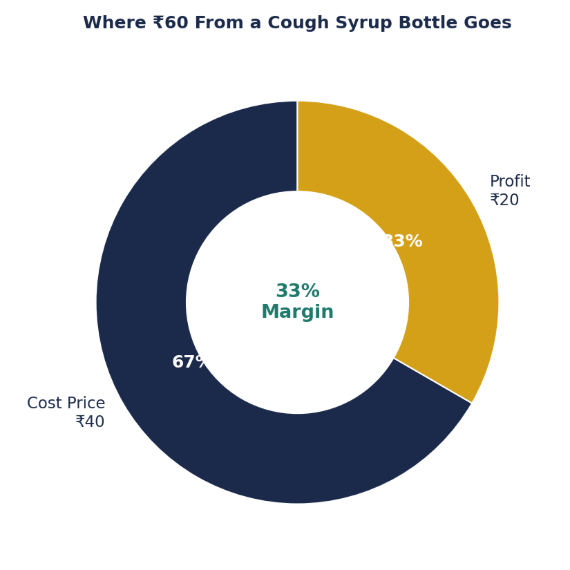
Let’s say you make a bottle of cough syrup. It costs you ₹40 to make. You sell that bottle to a chemist for ₹60. You made a profit of ₹20. Your profit margin is the part of the selling price.
Here is the simple formula:
Profit Margin (%) = (Selling Price − Cost Price) ÷ Selling Price × 100
In our example: (60 − 40) ÷ 60 × 100 = 33%.
So for every ₹100 worth of syrup sold, ₹33 is pure profit.
The other ₹67 covers the cost of making it.
Current Landscape (2026): Pharma Manufacturing Profit Margin in India by Type
The pharmaceutical manufacturing industry in India generally ensures 15% to 45% profit margins.
But the profit percentage is entirely up to how you choose to run your business.
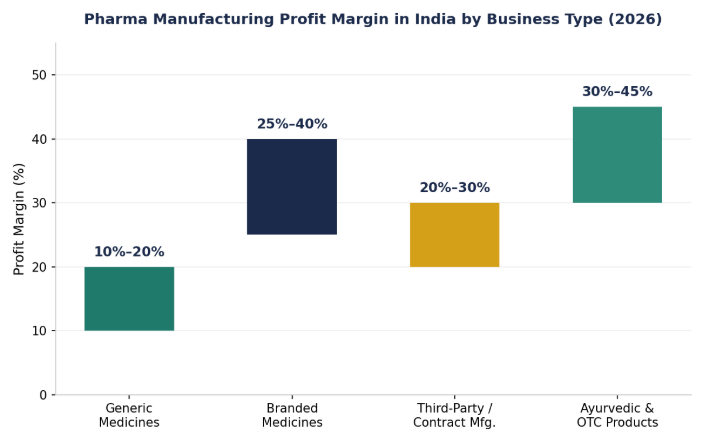
Let’s look at the average profit margins for the different types of manufacturing:
| Business Type | Typical Profit Margin | Why? |
|---|---|---|
| Generic Medicines | 10% – 20% | Made in large quantities. The profit per bottle is small, but you are selling millions of them! |
| Branded Medicines | 25% – 40% | These have unique brand names. People trust the brand name and pay a premium price for it. |
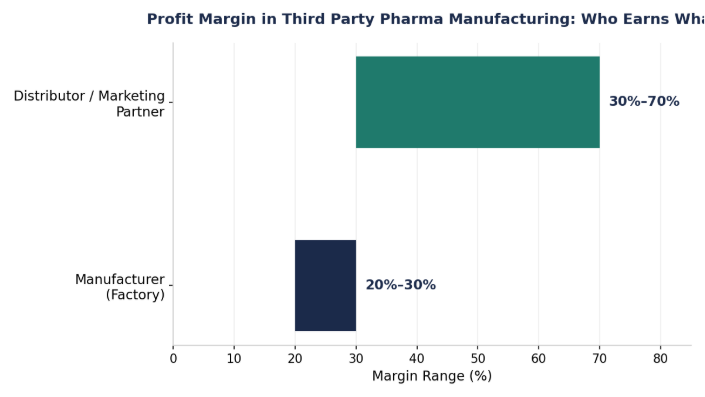
| Third-Party / Contract Manufacturing | 20% – 30% | You make medicines for other companies. You don’t have to spend money on marketing, which keeps profits steady. |
| Ayurvedic & OTC Products | 30% – 45% | Daily health products like vitamins or herbal syrups. They have fewer government price restrictions. |
This table shows why the pharmaceutical manufacturing profit margin in India is not one fixed number.
A company that sells branded Ayurvedic tonics earns very differently from a company that makes plain generic Paracetamol tablets. Location, order size, and product type all change the final number.
How to Grow Profit with Third-Party Pharma Manufacturing
Building up your own huge pharmaceutical factory is costly, sometimes even more than ₹5 crores! You need big machines, advanced laboratories and hundreds of workers.
So, many smart businesses prefer a fast-track method called third-party pharma manufacturing to increase their pharma manufacturing profit margin in India.
Steps for Third Party Manufacturing:
1. Choose a brand name and decide the type of medicine you want to market under this brand name.
2. You get a factory that is already running to produce the medicine for you.
3. Your brand name is put on the packaging and then you receive the finished boxes.
4. The sale and distribution of the medicine to doctors and pharmacies is your sole responsibility.
Third-party pharma manufacturing has very attractive profit margins. You don’t have to worry about running a factory, investing in expensive machinery or complex regulatory safety checks, so your risk is extremely low.
The company marketing the final branded product can often achieve gross profit margins of between 30% and 70%! This way, the profit margin in third-party pharma manufacturing can go higher.
Key Factors Influencing Pharma Manufacturing Profit Margin in India
A few things decide whether your pharma manufacturing profit margin in India sits at the low end or the high end. Here are the three biggest ones.
Order Volume
Bulk manufacturing lowers the cost of each unit. Buying raw material in large amounts helps. For example, if you buy 10,000 tablets, the factory might charge you more per pill. But if you buy 1,000,000 tablets, the raw material cost plummets. This instantly increases your profit margins.
Government Regulations
The Drug Price Control Order, or DPCO, sets a top price for some essential medicines. If your product is on this list, your pharmaceutical manufacturing profit margin in India will be capped by law. This happens no matter how well you run your business. Products outside the DPCO list have much more freedom in price.
Therapeutic Category
Medicines for long-term conditions, like diabetes or blood pressure, are sold all year round. They build loyal, repeat customers. This helps keep healthy margins. Cough and cold syrups, for example, are seasonal medicines that sell in short bursts. This can leave factories with idle machines for months. That quietly eats into yearly profit.
How to Increase Profit Margins in the Pharmaceutical Business
Pick high-margin products
Nutraceuticals and OTC products beat generics every time — fewer price controls, better margins.
Skip the factory
Third-party manufacturing saves you ₹2–5 crore upfront. Same quality, much lower cost.
Own your territory
Monopoly rights mean no one undercuts you in your own area. Lock it in early.
Claim government benefits
Baddi and Solan manufacturers save you 10–20% per unit. Most people never bother to ask.
Types of Profit Margins in Pharma
Three numbers matter:
Gross Profit Margin — revenue minus production cost. Nothing else deducted.
Operating Profit Margin — after marketing and admin costs.
Net Profit Margin — what actually lands in your account after everything.
Pharma average: 40–80% gross, 15–30% net. Higher than most industries.
What Each Model Actually Earns
Branded Companies — 25–40%. Patents let them charge premium for years.
Generic Manufacturers — 10–20%. Lower margins but massive volumes.
PCD Franchise — distributors earn 20–35%, manufacturers earn 30–50%.
Third-Party Manufacturing — 15–25%. No marketing cost. Steady income.
OTC and Ayurvedic — 30–60%. Fewer price controls, strong repeat sales.
What Moves Your Margin Up
Right product + monopoly rights + strong marketing = highest possible margin. Remove any one of these and it shows immediately.
Conclusion
So, how profitable is the pharmaceutical manufacturing business in India? The honest answer is: it depends on your model. Generic manufacturing gives you safety in numbers, but thinner margins.
Branded and ayurvedic products have higher margins, but require more aggressive marketing.
Third-party manufacturing sits in a comfortable middle ground. It lets you enter this booming industry without the huge upfront cost of a factory.
Whichever path you choose, it is important to know your true pharma manufacturing profit margin in India. That, and not just your sales numbers, is the key to building a healthy pharma business.
If you are looking to explore third-party manufacturing for your pharma brand, we at JM Laboratories have got you covered. We are a pharma manufacturing company that is WHO, GMP and ISO certified. We manufacture products like tablets, capsules, syrups and powders.
To know more, please contact us at +91-9216310884.
Also Check: Top 10 Third-Party Manufacturing Companies in India
Frequently Asked Questions FAQs
Q1. What are the profit margins of pharmaceutical manufacturing companies?
Ans. Pharma manufacturing profit margin in India is generally in the range of 15% to 45%. This is higher than other manufacturing sectors like textiles or food processing. However, your profit will depend a lot on your product mix, your licenses and the efficiency of your factory.
Q2. Is pharmaceutical a profitable venture?
Ans. Yes, it is one of the most stable and profitable sectors in the world. People need medicine to stay healthy, and so the demand remains high even when the economy is down.
Q3. What is the investment required for third-party pharma manufacturing?
Ans. One of the best parts of third-party manufacturing is the low barrier to entry. No need for crores of rupees. You can start your own medicine brand quite easily with an initial investment of ₹50,000 to ₹1,500,000, depending upon the minimum order requirements of the factory.
Q4. Why are margins on generics lower than on branded medicines?
Ans. As the formulas of generic medicines are no longer under patent protection, any certified company can produce them. There are so many companies that make the same drug. They compete on price, which drives the individual profit margin down. But they make up for it by selling in vast numbers!
Q5. What documents do you require to work with a third party manufacturing company in India?
Ans. You will require a valid Drug License, GST Registration number and a registered trademark for your unique brand name.