
What is third party medicine manufacturing?
Third party medicine manufacturing is a model where a brand owner hires a licensed pharma company to make, test and pack medicines under the brand’s name. In India, it removes plant setup costs and speeds up launch. The partner needs a valid manufacturing licence and WHO-GMP certification.
Setting up a production plant from scratch requires significant investment, stringent regulatory approvals, and substantial operational upkeep. This is why several healthcare brands rely on third party medicine manufacturing to effortlessly start and scale their drug brands.
In this business model, you choose the medicines, the brand name and the packs. Your partner makes, tests and packs them. This guide explains how the model works, what it costs, which papers you need and how to pick the right partner in 2026.
What is Third Party Medicine Manufacturing?
In simple terms, one company, the brand owner, asks another licensed company to make its medicines. The packs carry the brand owner’s name, but the maker runs the production line.
Think of it like ordering custom-made furniture. You decide the design, the size and the finish. The workshop has the tools, the skilled staff and the space to build it well. However, whatever piece of furniture is created will belong to you. In pharma, the workshop is a licensed plant with trained chemists and testing labs.
The model suits new entrepreneurs, PCD pharma companies, distributors and established brands that want a wider range. Many businesses begin with a handful of products and add more as sales grow. Others use it to fill gaps in their range without touching their own plant.
Why Choose Third Party Pharmaceutical Manufacturing in India?
Here is why a 3rd party pharma manufacturing company in India works so well for brand owners.
Reduced Investment Cost:
Lower investment is the first reason. You pay for the medicines you order, not for land, buildings or machines. There is no need to establish a manufacturing plant, which saves years of approvals and a large amount of capital.
Leveraging Advanced Facilities:
You also get access to modern manufacturing facilities. Good plants already own tablet presses, capsule fillers, liquid lines and testing labs. That means a faster product launch, often within weeks instead of years.
Flexibility:
You can order small batches while testing a market and raise volumes as demand grows. This protects you from stock that sits unsold on a shelf.
Which Medicines Can Be Manufactured Through Third Party Pharma Manufacturing?
Most common dosage forms can be made on contract with a 3rd party pharma manufacturing company in India.
- Tablets and capsules are commonly manufactured products.
- Syrups and oral liquids are also manufactured, along with dry syrups, which are powders that a chemist mixes with water for children.
- Many plants have expertise in manufacturing injections, softgel capsules and sachets.
- Topical products such as creams, gels and ointments are common too.
- Nutraceuticals and supplements, including vitamins and protein products, are popular with new brands.
- Ayurvedic or herbal products are possible where the plant holds the right licence.
Always confirm that the plant has approval for the exact dosage form you want. Each form needs its own machines and approvals.
Step-by-Step Process of Third Party Medicine Manufacturing
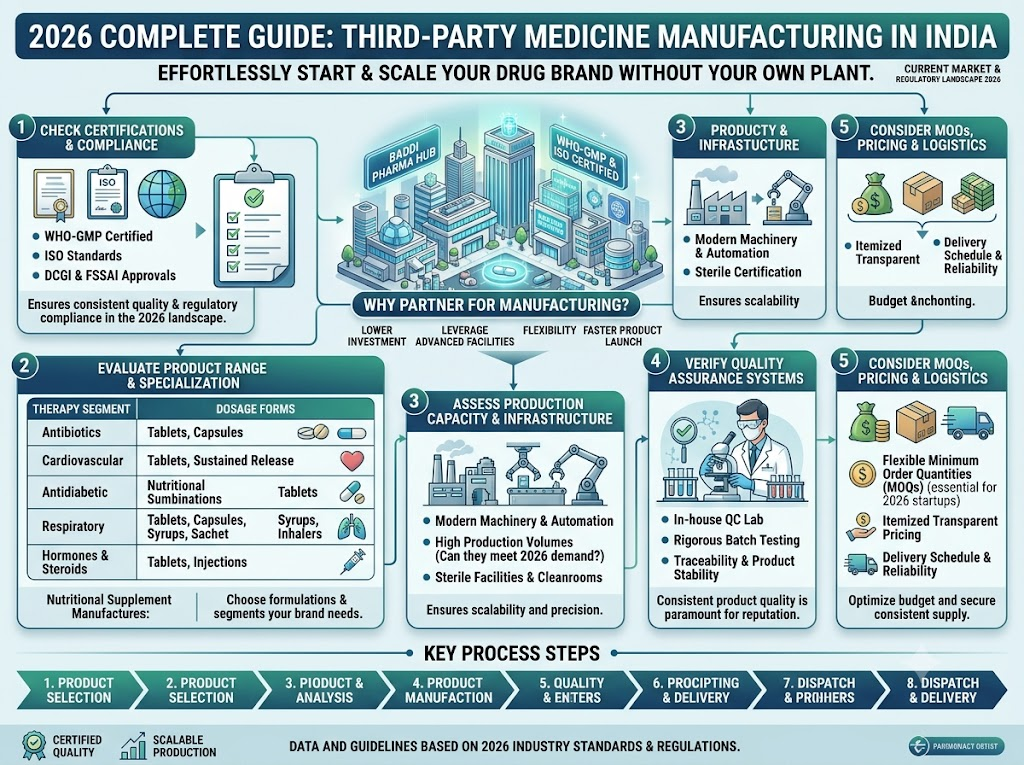
Here is how you can start working with a third party medicine manufacturer.
Step 1: Select Your Product Range
Start with the therapy areas you understand and the medicines that doctors or chemists ask for. A focused range of 10 to 20 products is easier to market than a scattered one. You can grow the list later, so start with products you can explain clearly.
Step 2: Find a Suitable Manufacturing Company
Search online, check trade directories and ask other brand owners for referrals. Shortlist three or four companies and speak to each one. A short call tells you a lot about how they work.
Step 3: Check Licences and Certifications
Ask for the manufacturing licence, the WHO-GMP certificate and the ISO certificate. Ask to see the originals, not just photocopies. Make sure the licence covers your dosage forms.
Step 4: Pricing
Ask how much it costs to manufacture your product in a certain quantity. Generally, a manufacturer has its own MOQ or minimum order quantity, meaning that you have to buy their lowest number of batch to get started. Choose the one offering flexible MOQs.
Step 5: Finalise the Formulation and Packaging
Confirm the formula, strength, shelf life, pack type and artwork. Read every line of the label before you approve it, because mistakes here are costly to fix.
Step 6: Place the Manufacturing Order
Place your order with quantities and delivery dates.
Step 7: Production and Quality Testing
The plant buys raw materials, makes the batch and tests it at several stages. Ask for a certificate of analysis with each batch.
Step 8: Product Dispatch and Delivery
Finished goods are boxed and sent to your location. Check the stock against the invoice when it arrives, and report any damage or shortage right away.
Documents Required for Third Party Medicine Manufacturing
Here is a list of essential documents you need to opt for third party pharma manufacturing services.
Some companies may ask for extra documents depending on the product and their own rules. Ask for the full checklist at the start, so nothing delays your first order.
How Much Does Third Party Medicine Manufacturing Cost in India in 2026?
There’s no single price list, and any company that quotes one without asking questions deserves a second look. Several factors decide the final cost.
Product formulation sets the base price. A simple paracetamol tablet costs far less to make than a combination injection. Raw material prices move with the market and can change between orders.
The active ingredients, packaging materials, machine batch size and analytical tests are different for each pharmaceutical product.
For example, an antibiotic capsule packed in Alu-Alu foil, using an imported API, will naturally have a different cost structure than a simple liquid cough syrup packed in a PET bottle.
Generally, it may take nearly INR 2 lakh to INR 5 lakh for a portfolio of 5-10 products. However, ask for a complete cost breakdown from your manufacturer so that you can create your budget accordingly.
How to Choose the Best Third Party Medicine Manufacturer in India
Picking the right partner matters more than any other decision on this list. A good third party medicine manufacturer in India will answer your questions openly and show you the plant. Check these points before you sign.
- Experience comes first, because companies with years of production behind them solve problems faster.
- Look for valid licences and GMP-compliant facilities that follow Revised Schedule M.
- Ask how the quality control team tests raw materials, samples taken during production and finished goods.
- See if their MOQ meets your budget.
- Finally, notice how the team treats you before you pay. Good customer support shows up in quick replies and straight answers.
- Ask for client references and call at least one of them.
Why Choose JM Laboratories as Your Trusted Third Party Medicine Manufacturer in India
JM Laboratories is a third-party pharma manufacturing company in India with its plant in Baddi, Himachal Pradesh.
Here is why we meet all criteria to become your trusted third-party manufacturer in India.
- The company holds WHO-GMP, ISO and GLP certifications, which cover the quality checks most brand owners ask about first.
- Its range includes tablets, capsules, syrups, dry syrups, injections, softgels and nutraceuticals.
- We have the capacity to make over 50 million tablets and 20 million capsules every month, so both small launches and large orders are possible.
- New brands will find the terms friendly. JM Laboratories offers low minimum order quantities, flexible pricing and packaging support, along with timely delivery across India.
- Whether you run a PCD company or a private label business, you get one partner for production, testing and packing.
If you want to learn how our third-party manufacturing can work for your project, call us at +91-9216310884.
Conclusion
Third-party medicine manufacturing gives you a practical way to enter the pharma market without building a plant. You save money, launch faster and spend your time on sales. T
The key is a partner with valid licences, strong quality checks and honest pricing. Compare a few companies, ask direct questions and start with a small order. Your first batch will tell you a lot about the long-term relationship. Rules and prices change from year to year, so confirm the current requirements with the company and your state drug authority before you commit.
FAQs
Q1. What is third-party manufacturing?
Ans. Third-party manufacturing is a model in which you hire a manufacturer to get your products made. This way, you don’t need to set up a factory or hire staff.
Q2. What is minimum order quantity?
Ans. It is the smallest batch a company will make. It varies by product and by company.
Q3. Which dosage forms can be made?
Ans. A third-party manufacturer generally makes tablets, capsules, syrups, dry syrups, injections, softgels, sachets and topical products.
Q4. What certificates should I look for?
Ans. Ask for the manufacturing licence, plus WHO-GMP, ISO and GLP certificates.
Q5. How can I verify a licence?
Ans. Ask for a copy and confirm the details with the state drug control department.
Q6. Does the plant handle packaging?
Ans. Most do. They can print your artwork on cartons, labels and leaflets.
Q7. Is the business profitable?
Ans. It can be. Lower fixed costs help, but results depend on your pricing, marketing and distribution.
Q8. What mistakes should I avoid?
Ans. Choosing on price alone, skipping licence checks and approving labels without a careful review.