
Featured Snippet Box :- Pharmaceutical manufacturing in India is how raw ingredients become finished medicines like tablets, capsules, syrups and injections. Factories mix, test, pack and release each batch under WHO-GMP standards. With about 10,500 manufacturing units, India supplies roughly 20% of the world’s generic medicines by volume.
Pharmaceutical manufacturing is the backbone of India’s healthcare system. Every tablet, syrup, and injection on a chemist’s shelf starts in a factory, and India has more than 3,000 drug companies operating about 10,500 manufacturing units.
The country ranks third in the world by production volume and meets roughly 20 per cent of global generic demand. No wonder people call it the pharmacy of the world.
This guide gives a clear look at pharmaceutical manufacturing in India. It covers the main manufacturing types, the production process, the leading companies and the pharmaceutical manufacturing standards every plant must follow.
If you run a pharma business, a distribution firm or a startup, or you are an entrepreneur planning your first launch, use it to compare your options and choose the right manufacturing partner.
What is Pharmaceutical Manufacturing?
Pharmaceutical manufacturing is the process of turning raw materials into finished medicines that are safe to use. Factories take active ingredients and supporting materials, mix them in exact amounts, shape them into tablets, capsules, liquids or injections, test them and pack them.
The manufacturers have several quality checks to make sure that a medicine is safe and effective.
What Are the Different Types of Pharmaceutical Manufacturing?
1. Formulation Manufacturing
Formulation plants turn ready-made active ingredients into the dosage forms patients actually use. In other words, active ingredients are mixed with inactive carriers to make medications.
These include tablets, capsules, syrups, suspensions and oral powders. They also cover topical products such as ointments, creams and gels.
2. API Manufacturing
Active pharmaceutical ingredients (APIs) are the chemicals that make a medicine work. API plants make them by chemical synthesis or fermentation. The strength and purity of the API decide how well the final medicine performs. India holds nearly 8 per cent of the global API industry.
A weak API can spoil a well-made formulation, so buyers should always ask where a maker sources its APIs.
3. Injectable and Sterile Manufacturing
Injections go straight into the body, so there is no room for germs. Sterile plants make vials, ampoules and prefilled syringes inside cleanrooms with filtered air. Because the rules are strict, an injectable unit costs more to build and run than an oral dosage plant.
4. Vaccine and Biological Product Manufacturing
Vaccines and biological medicines come from living cells, not from simple chemicals. They need tightly controlled production, cold storage and long testing cycles, and each batch is checked for potency and safety. India supplies about 60 per cent of the vaccines bought by UNICEF. A small error in temperature or handling can ruin a whole batch, so these plants invest heavily in monitoring.
5. Nutraceutical and Supplement Manufacturing
This part involves the manufacturing of vitamins, protein powders, essential minerals, softgels, and daily wellness supplements.
6. Ayurvedic and Herbal Medicine Manufacturing
Ayurvedic and herbal makers use plant-based ingredients and traditional formulas. They need a licence from the State Licensing Authority under the Drugs and Cosmetics Act, 1940, and they must follow the good manufacturing practice rules set out for Ayurvedic products.
Raw herbs are checked for identity, purity and impurities such as heavy metals and pesticides. Consistent sourcing matters because plant quality changes with season and region.
Pharmaceutical Manufacturing Process: How it Works
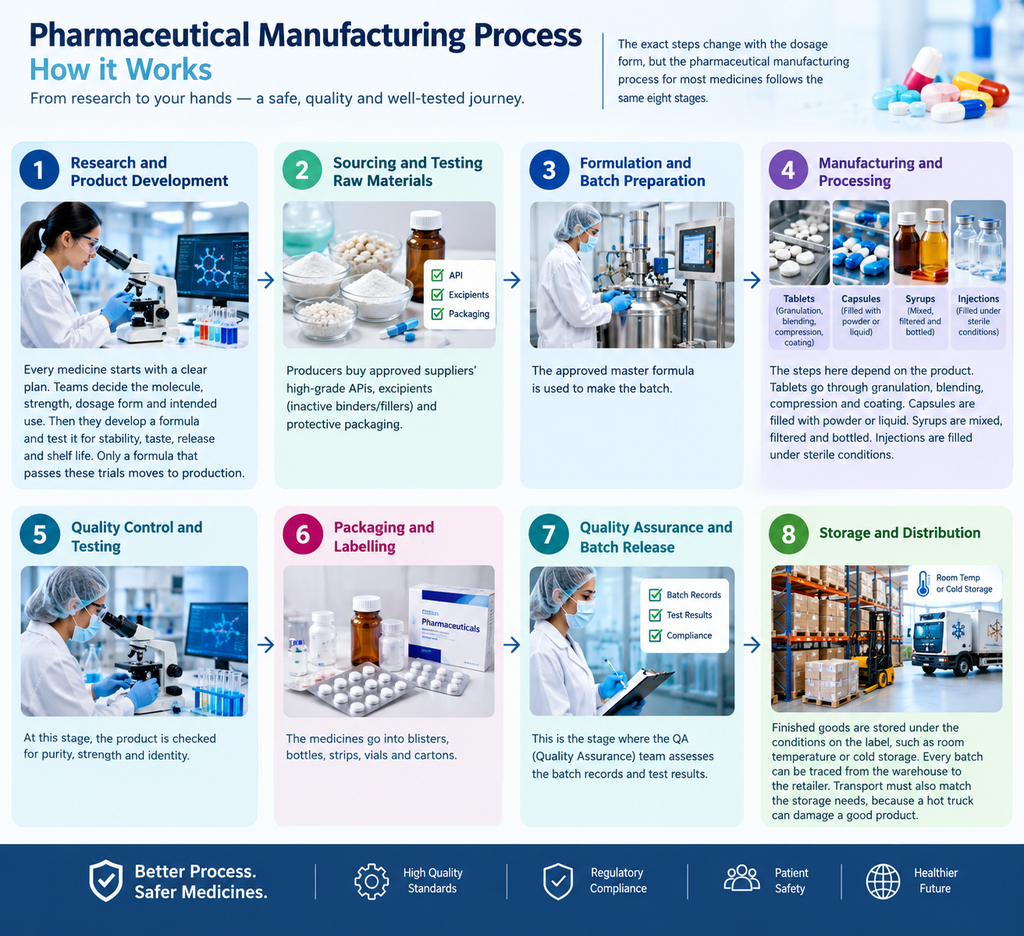
The exact steps change with the dosage form, but the pharmaceutical manufacturing process for most medicines follows the same eight stages.
Step 1. Research and Product Development
Every medicine starts with a clear plan. Teams decide the molecule, strength, dosage form and intended use. Then they develop a formula and test it for stability, taste, release and shelf life. Only a formula that passes these trials moves to production.
Step 2. Sourcing and Testing Raw Materials
Producers buy approved suppliers’ high-grade APIs, excipients (inactive binders/fillers) and protective packaging.
Step 3. Formulation and Batch Preparation
The approved master formula is used to make the batch.
Step 4. Manufacturing and Processing
The steps here depend on the product. Tablets go through granulation, blending, compression and coating. Capsules are filled with powder or liquid. Syrups are mixed, filtered and bottled. Injections are filled under sterile conditions.
Step 5. Quality Control and Testing
At this stage, the product is checked for purity, strength and identity.
Step 6. Packaging and Labelling
The medicines go into blisters, bottles, strips, vials and cartons.
Step 7. Quality Assurance and Batch Release
This is the stage where the QA (Quality Assurance) team assesses the batch records and test results.
Step 8. Storage and Distribution
Finished goods are stored under the conditions on the label, such as room temperature or cold storage. Every batch can be traced from the warehouse to the retailer. Transport must also match the storage needs, because a hot truck can damage a good product.
Types of Pharmaceutical Manufacturing in India
1. In-House Manufacturing
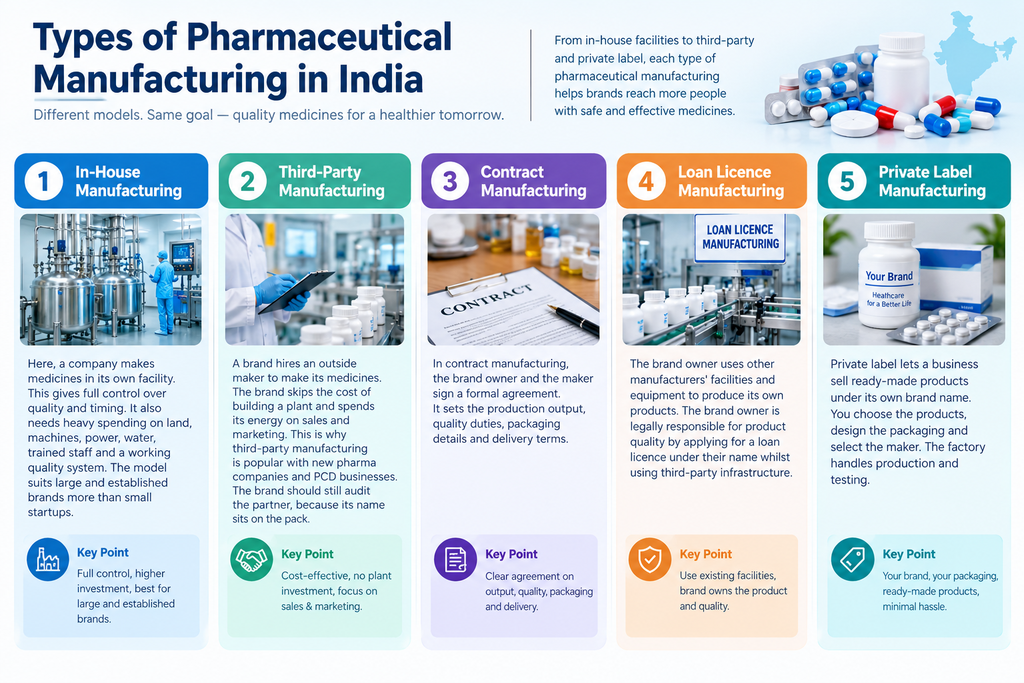
Here, a company makes medicines in its own facility. This gives full control over quality and timing. It also needs heavy spending on land, machines, power, water, trained staff and a working quality system. The model suits large and established brands more than small startups.
2. Third-Party Manufacturing
A brand hires an outside maker to make its medicines. The brand skips the cost of building a plant and spends its energy on sales and marketing. This is why third-party manufacturing is popular with new pharma companies and PCD businesses. The brand should still audit the partner, because its name sits on the pack.
3. Contract Manufacturing
In contract manufacturing, the brand owner and the maker sign a formal agreement. It sets the production output, quality duties, packaging details and delivery terms.
4. Loan Licence Manufacturing
The brand owner uses other manufacturers’ facilities and equipment to produce its own products. The brand owner is legally responsible for product quality by applying for a loan licence under their name whilst using third-party infrastructure.
5. Private Label Manufacturing
Private label lets a business sell ready-made products under its own brand name. You choose the products, design the packaging and select the maker. The factory handles production and testing.
Top 10 Pharmaceutical Manufacturing Companies in India (2026)
The table below lists ten of the best-known pharmaceutical manufacturing companies in India.
| No. | Company | Location | Known For |
| 1 | JM Laboratoires | Solan, Himachal Pradesh | WHO-GMP and ISO 9001:2015 certified. Makes tablets, syrups, injections and capsules for cardiology, general medicine, paediatrics, gynaecology and critical care |
| 2 | ASPO Pharmaceuticals LLP | Zirakpur, Punjab | Contract manufacturing with WHO-GMP and ISO 9001:2015 certification. Makes tablets, syrups, ointments and capsules. Works with around 600 B2B clients in six-plus countries |
| 3 | Inducare Pharmaceuticals | Jejuri, Pune, Maharashtra | FDA-approved plant. Custom manufacturing of tablets, capsules and liquids for cardiac care, diabetes, digestive health, dermatology, neuro care and vitamins |
| 4 | JM Laboratories | Solan, Himachal Pradesh | Operating since 2006 with ISO and WHO-GMP backing. Makes tablets, capsules, syrups and powders, with strength in heart health, diabetes and infections |
| 5 | Fossil Remedies | Changodar, Ahmedabad, Gujarat | Over 1,000 products across seven divisions: cardiology, neurology, dermatology, gynaecology, ophthalmology, nephrology and dentistry |
| 6 | Albert David | Kolkata, West Bengal | Makes Sodium Stibogluconate for leishmaniasis and the product Placentrex. Works with CSIR-IICB and Calcutta University on research |
| 7 | Caplin Point Laboratories Ltd. | Chennai, Tamil Nadu | Export-focused. Makes generic formulations, liquid injectables, freeze-dried vials, softgel capsules and oral solids. US FDA-approved plants serve Latin America, Africa and the US |
| 8 | Biocon Limited | Bengaluru, Karnataka | Started as an enzyme maker in 1978. Works on biologics, biosimilars, active ingredients and insulins for patients in more than 120 countries |
| 9 | Aurobindo Pharma Ltd. | Hyderabad, Telangana | Founded in 1986. Makes generic formulations and bulk drug ingredients at plants in Hyderabad and Vizag. Exports to over 150 countries and holds hundreds of US FDA approvals |
| 10 | Amol Pharmaceuticals Pvt. Ltd. | Sitapura, Jaipur, Rajasthan | WHO-GMP certified and founded in 1998. Makes tablets, capsules, dry syrups, oral powders and slow-release pellets. Offers contract and third-party manufacturing |
Major Manufacturing Hubs in India
Manufacturing in India clusters in a few regions. Each has its own strengths, tax benefits and supplier networks. The table shows where the work is concentrated.
| Hub | State or UT | What It Is Known For |
| Baddi and Solan | Himachal Pradesh | Formulation plants, industrial infrastructure and large production facilities |
| Hyderabad | Telangana | APIs, bulk drugs, formulations and biotechnology |
| Ahmedabad and Vadodara | Gujarat | Formulations, APIs and contract manufacturing |
| Mumbai and Pune | Maharashtra | Company headquarters, research centres, formulations and plants |
| Chandigarh, Panchkula and Mohali | Chandigarh, Haryana and Punjab | Regional pharma businesses, marketing firms and manufacturing partners serving northern India |
| Haridwar | Uttarakhand | Production facilities and industrial manufacturing infrastructure |
How to Choose the Right Pharmaceutical Manufacturing Company
A wrong partner can delay your launch and damage your brand. Use this checklist before you sign.
- Check the manufacturing licences and approvals, such as WHO-GMP, and confirm they are current.
- Visit or audit the quality control laboratory and ask how testing is done.
- Find out what product development, packaging and labelling support they offer.
- Compare prices, payment terms and delivery timelines.
- Review their records, legal compliance and how quickly they respond to queries.
- Request product samples and quality documents, such as test certificates, before placing a large order.
Conclusion
India’s strength in drug making comes from scale, skill and low cost. Whether you plan to start with a formulation, an injectable, a nutraceutical or an Ayurvedic range, success depends on choosing the right partner. Learn the pharmaceutical manufacturing process, understand the models and compare real quotes. Check the licences yourself. Pharmaceutical manufacturing in India rewards businesses that do their homework, and a careful choice today will protect your brand for years.
If you are looking for a quality manufacturing company, JM Laboratories ticks all the boxes. We are a WHO-GMP and ISO certified company offering a wide range of products with PCD pharma franchise and third-party manufacturing services. Contact us at +919216310884.
FAQs
What is pharma production?
It is the production of finished medicines from raw materials. It includes mixing, shaping, testing, packing and releasing each batch under strict quality rules.
Why is India called the pharmacy of the world?
India makes about 20 per cent of the world’s generic medicines by volume and supplies vaccines and APIs to many countries. It does this at a low cost.
What are the steps in the manufacturing process?
They run from product development to storage. In between come material tests, batch prep, processing, quality checks, packing and batch release.
Is a nutraceutical the same as a medicine?
No. Nutraceuticals are regulated as food products by FSSAI. Medicines are regulated as drugs and can make treatment claims.
What is contract manufacturing?
It is production under a formal agreement. The agreement covers output, quality duties, packaging and delivery terms.
Which Indian cities are major pharma hubs?
Baddi, Hyderabad, Ahmedabad, Vadodara, Mumbai, Pune, Haridwar and the Chandigarh, Panchkula and Mohali region are major hubs.
How much does it cost to start a manufacturing unit?
There is no fixed figure. Cost depends on the dosage form, plant size, machinery, utilities and licences. Injectable units cost more than oral units.
How can I verify a maker’s quality?
Ask for licences and certificates. Visit the plant if you can, and review the laboratory. Then request samples with test certificates.
Can a startup begin without its own plant?
Yes. Many startups use third-party, contract or loan licence manufacturing. This keeps the upfront spending low.