
Quick Answer
Most third-party pharma manufacturers in India ask for 2,000 to 10,000 units per SKU on tablets and capsules — the exact number depends on dosage form, packaging, and how much raw material the supplier needs to buy in bulk. If you’re shopping around, manufacturers in Baddi, Panchkula, and Chandigarh are usually more willing to negotiate down than the big hubs like Mumbai or Hyderabad. That makes them the better starting point for a new brand or PCD franchise that doesn’t want to sink lakhs into stock before knowing if the product sells.
If you’re launching a pharma brand on a tight budget, MOQ is probably the first thing you check before anything else. In other words, a third-party pharma manufacturer with low MOQ would be your top priority.
Most manufacturers in India ask for bulk orders — 50,000 units, sometimes more, per SKU. It means that you need to buy at least 50,000 units from them. That works fine for established companies. It doesn’t work for a start-up testing five products in a new market. This is why the search for a third-party pharma manufacturer with low MOQ has picked up so much over the past few years.
What Makes a Third-Party Pharma Manufacturer with Low MOQ Different
We have advised several times in our blogs that you should always prefer value over money. But that doesn’t mean a low MOQ manufacturer cuts corners on quality.
Even a reliable low MOQ manufacturer ensures quality, provided they are WHO-GMP certified with a proven track record.
You must be wondering how they produce smaller batches all while maintaining quality.
The manufacturer simply structures production runs differently. The production slots are often shared across multiple clients.
However, the price of each unit goes slightly higher. For a company still building its market, this “increased cost” is worth it.
The MOQ for third-party pharma manufacturing depends on several things: the dosage form, the packaging complexity, and the raw material sourcing. Tablets and capsules are usually easier to produce in small batches than injectables or ointments, because the machine changeover cost is lower.
Why May MOQ Change By Region?
Minimum Order Quantity (MOQ) for pharma manufacturing in India varies a lot by region too. Manufacturers in Baddi, Panchkula, and Chandigarh tend to be more flexible with MOQs than manufacturers in larger industrial hubs like Hyderabad, Mumbai and Gujarat.
These bigger zones have huge, automated factories to make millions of pills at once to cover their costs. However, most plants in Himachal Pradesh and Haryana use smaller, adaptable machines that are quick and cheap to reset for different medications. Plus, there are hundreds of factories over there, making them compete for business. They agree to make smaller test batches for local companies.
| What to Look At | Baddi / Panchkula / Chandigarh | Big Hubs (Gujarat, Hyderabad, Mumbai) |
|---|---|---|
| Main Focus | Making smaller batches for local brands, new businesses, and small distributors. | Making huge orders for major national brands and international exports. |
| Machines Used | Flexible, smaller machines that are quick and easy to reset for different medicines. | Giant, high-speed automated machines built to run non-stop for one product. |
| Minimum Order Size | Low & Flexible: Willing to make small test orders (like 1,000 to 3,000 boxes). | High & Strict: Require very large orders (often 50,000+ boxes minimum). |
| Main Advantage | Easy to start small, customize orders, and launch new products quickly. | Super low price per pill when buying in massive amounts. |
Anyone comparing quotes for Minimum Order Quantity pharma manufacturing in India should ask each supplier the same set of questions, so the numbers can actually be compared.
Understanding Third Party Manufacturing
MOQ Requirements
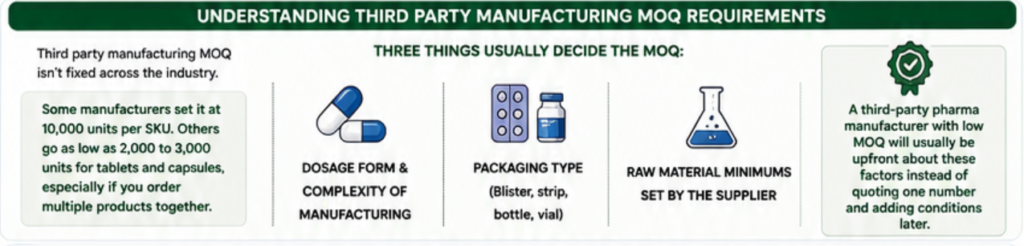
Third party manufacturing MOQ isn’t a fixed number across the industry. Some manufacturers set it at 10,000 units per SKU. Others go as low as 2,000 or 3,000 for tablets and capsules, particularly if you’re ordering multiple products in one go.
Make sure to ask them directly when it comes to MOQ.
Three things usually decide the number:
- Dosage form and complexity of manufacturing
- Packaging type (blister, strip, bottle, vial)
- Raw material minimums set by the supplier
A third-party pharma manufacturer with low MOQ will usually be upfront about these factors instead of quoting one number and adding conditions later.
Minimum Batch Size for Pharma Manufacturing: What Actually Drives It
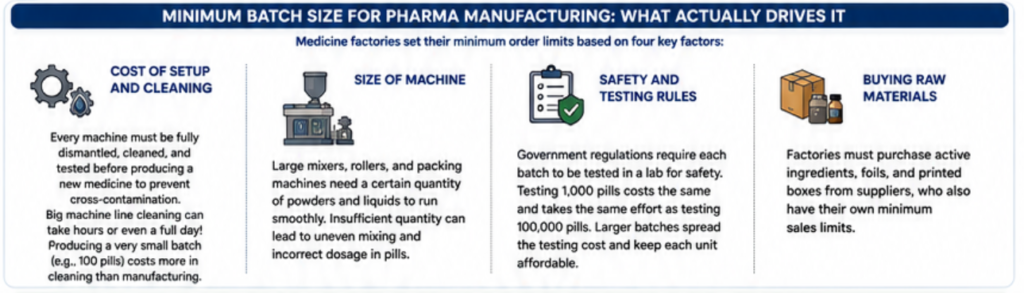
So, what actually makes medicine factories set their minimum order limits? It is all decided by four main factors
1. Cost of Setup and Cleaning
Before any new medicine can be manufactured in a factory, every single machine must be completely taken apart, cleaned from top to bottom and tested. This keeps the various drugs from interfering with each other. Big machine line cleaning can take hours or even a full day! If they only made 100 pills, it would cost a factory more money and time to clean out the machines than make the medicine.
2. Size of machine
Pharmacies have large mixers, rollers and packing machines. These machines require a certain amount of powders and liquids in them for their smooth functioning. If you don’t put enough ingredients in, the machine can’t mix them evenly. As a result, the pills won’t have the right amount of medicine.
3. Safety and testing rules
Government regulations require that each batch of medicine be tested in a lab to ensure it is safe. Testing 1,000 pills from the factory costs the same and takes the same amount of work as testing 100,000 pills. Making larger batches spreads that testing cost out, keeping each box affordable.
4. Buying Raw Materials
Factory owners have to buy active ingredients, foils, and printed boxes from supplier companies, who also have their own minimum sales limits.
How to Pick the Right Low MOQ Pharma Manufacturer India
Not every manufacturer advertising low MOQ actually delivers on it. Some quote a low number to get the enquiry, then add conditions once you’re in discussions. A few things to check before signing anything:
- Ask for the MOQ per product, not a blanket figure across the whole range
- Check whether the quoted MOQ includes packaging customisation
- Confirm the manufacturer holds a valid WHO-GMP or GMP certification
- Ask how many SKUs you can combine in a single production run
- Get the batch size and lead time in writing

JM Laboratories: A Practical Option for Flexible MOQs
We at JM Laboratories offer negotiable MOQs, which means the starting order size is quite flexible. It’s discussed based on the product, the packaging, and the client’s growth plan. For a new PCD franchise or a small brand testing the market, this kind of flexibility matters the most. To learn more about how we can set our MOQs around your requirements, please contact us at +91-9216310884.
Getting Started with Low MOQ
If you’re comparing options, don’t just look at the number. Look at what’s included in that number, such as testing, packaging, and documentation, and whether the manufacturer is willing to put it in writing. A third-party pharma manufacturer with low MOQ that’s confident about its process will usually share this without hesitation.
Small order sizes make sense for new brands, regional launches, and companies testing a new therapy segment. Once your product proves itself, most manufacturers are happy to scale the batch size up. Third-party pharma manufacturer selection with low MOQ is about balancing cost, quality and flexibility. Starting small doesn’t mean staying small. It means starting without unnecessary risk.
FAQs
Q1. What is a typical MOQ for third-party pharma manufacturing in India?
Ans. The number may vary by dosage form and manufacturer. Generally, tablets and capsules are available at some point between 2,000 and 10,000 units per SKU.
Q2. Will a low MOQ impact product quality?
Ans. No. The batch size does not impact formulation, testing, or GMP compliance. It only changes the size of the production run. That’s exactly why a good third-party pharma manufacturer with low MOQ can still meet full regulatory standards.
Q3. Can MOQ be negotiated?
Ans. Yes. Many manufacturers, including JM Laboratories, are willing to talk about and adjust the MOQ depending on the product and packaging needs.
Q4. Should I ask MOQ directly?
Ans. Of course, yes. In fact, it is highly recommended to have a word directly with the manufacturer.
Q5. How does low MOQ help apart from saving money?
Ans. Not only does low MOQ reduce upfront capital, but it also speeds up market entry and prevents dead stock.
Also Check: Top 10 Third-Party Manufacturing Companies in India